Building a Multi-Agent AI Company Is Harder Than You Think
Having a single AI agent handle a specific task is already impressive.
But asking one agent to build an entire product, manage a workflow, make architectural decisions, write code, review it, deploy it, document it, and coordinate everything end-to-end? That’s where things become complicated very quickly.
If you don’t optimize how you use tokens, context windows, memory, and orchestration, you will end up burning massive amounts of tokens without actually accomplishing the job.
This is exactly why multi-agent systems have become so popular.
But the reality is:
Most people underestimate the actual complexity of running a fleet of AI agents.
The biggest cost is not token usage.
The real challenge is orchestration.
The Illusion of “Just Add More Agents”
At first, multi-agent systems sound simple.
You create:
And suddenly, you think you’ve built an AI software company.
But as your agent roster grows, your operational complexity grows even faster.
You are no longer managing prompts.
You are managing:
At this stage, you are effectively building a real company — except your employees are AI agents.
And trust me, the operational pain is very real.
I’ve gone through both:
The similarities are surprisingly close.
The Real Problems You Face With Multi-Agent Systems
1. Context Explosion
One agent can already consume huge amounts of context.
Now imagine:
Without proper context management, your token usage becomes uncontrollable.
Worse:
Agents begin hallucinating assumptions because they lack the full operational picture.
2. Lack of Determinism
This is one of the biggest mistakes people make.
Humans naturally assume:
“This step is obvious.”
AI agents do not.
If you allow agents to “figure things out” without strict governance, your system will eventually become chaotic.
You must define:
Determinism is not optional.
Governance is not optional.
Without them, your AI company becomes impossible to scale.
3. Orchestration Becomes the Real Product
Most people focus too much on the agents themselves.
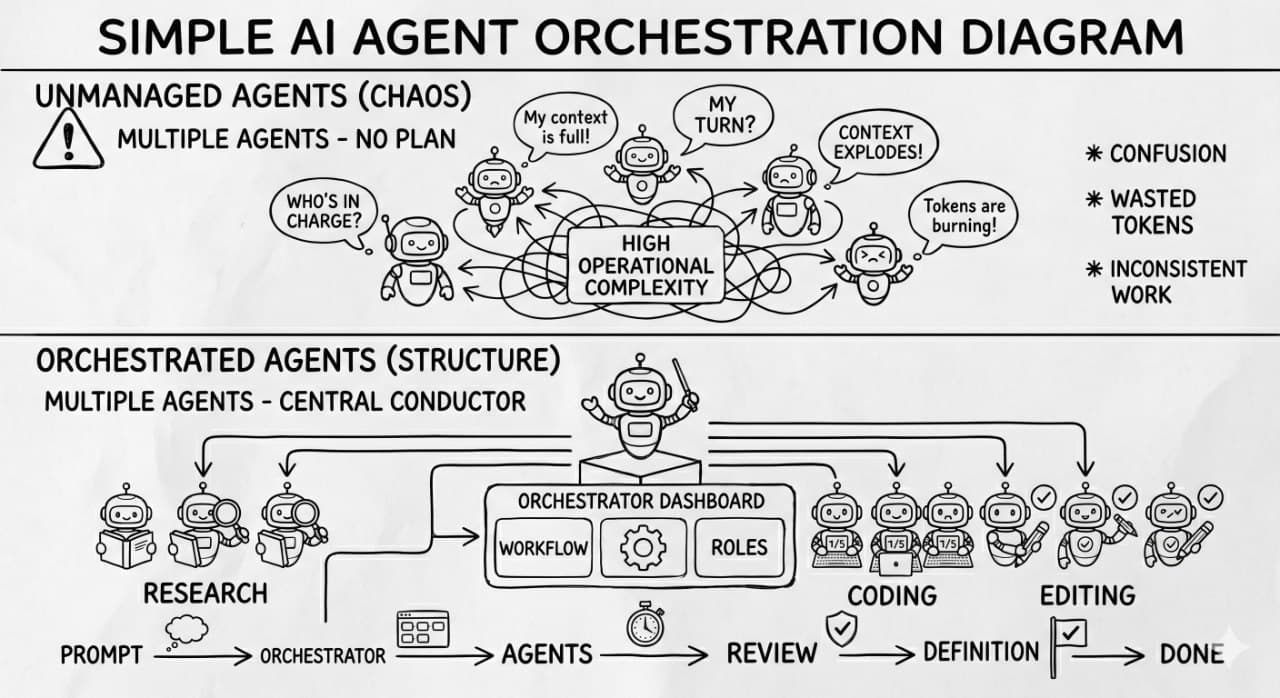
But the orchestrator is actually the heart of the system.
Your orchestrator must:
At scale, orchestration becomes more important than the agents themselves.
4. Communication Between Agents
Peer-to-peer communication sounds attractive in theory.
In practice, it often becomes messy.
When agents communicate directly:
A centralized orchestrator creates:
This is extremely important for production-grade AI systems.
5. Definition of Done Matters More Than Ever
Humans can infer completion.
Agents cannot.
You need explicit success criteria for every workflow step.
For example:
Without this structure, agents will prematurely mark tasks as completed.
Building an AI Company Instead of Just Agents
The moment you move into multi-agent systems, you stop building prompts.
You start building:
This is why thinking about AI agents as “employees” is actually the correct mental model.
Because eventually:
You are building a software company powered by AI.
OpenClaw vs Hermes Agent
Right now, two of the most interesting platforms for building AI agent fleets are:
Understanding their architecture, orchestration model, memory handling, and workflow design is critical before choosing one.
Each one approaches:
…in very different ways.
And choosing the wrong architecture early can create massive operational problems later.
What’s Next
In the upcoming posts, I’ll share my experience working with both OpenClaw and Hermes Agent.
I’ll break down:
Because building a successful AI fleet is not about creating more agents.
It’s about creating a system that can reliably govern them.